Seller Ownership from Purchase Agreement to Closing
October 24, 2026
When working with multiple sellers who own a property as joint tenants with right of survivorship, the AAR Purchase Agreements ask the sellers to determine whether they wish to maintain their joint tenancy with right of survivorship or allow it to convert to a tenancy-in-common from the Agreement Acceptance Date through closing. This document is to help you understand that decision, the legal reasons behind it, and your role.
This guide is intended for information only and does not constitute legal advice. If legal advice is needed, please contact an attorney.
What part of the AAR Purchase Agreements are we talking about?
We’re talking about the second part of Paragraph 13 of the AAR Purchase Agreement. It looks like this:

Remind me, what do the terms “joint tenancy with right of survivorship” and “tenancy-in-common” mean?
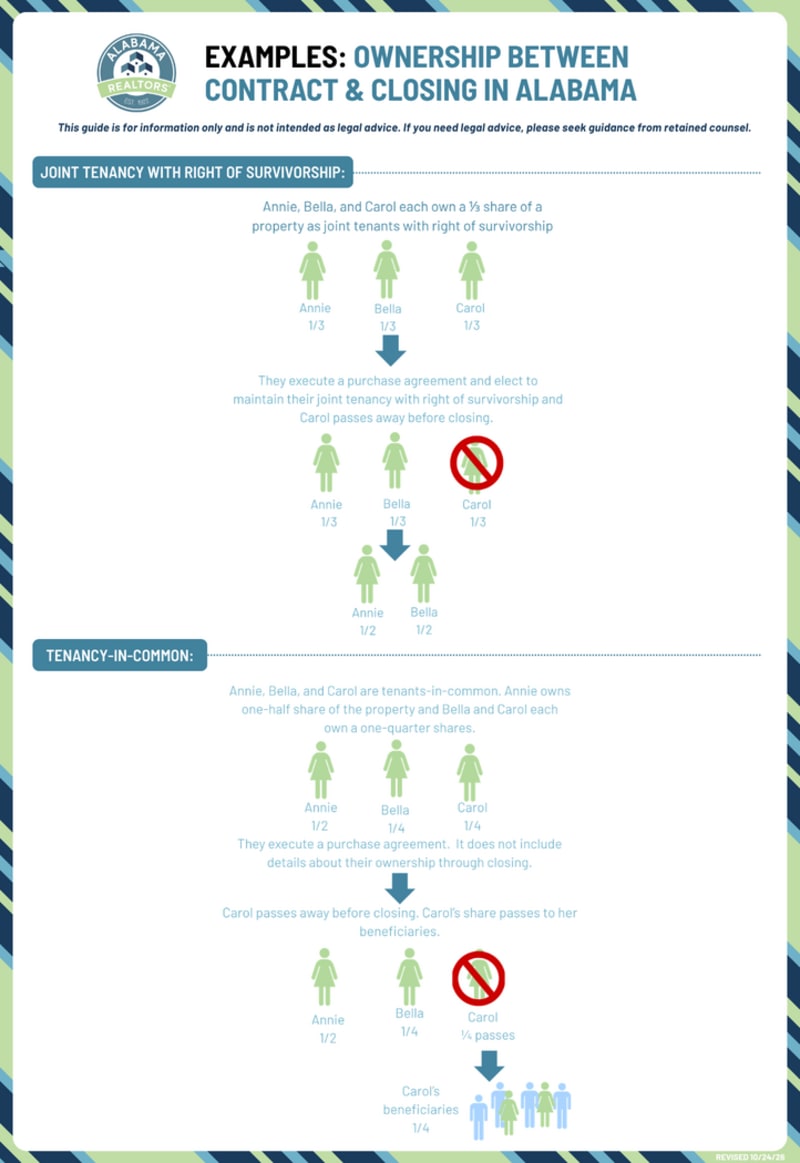
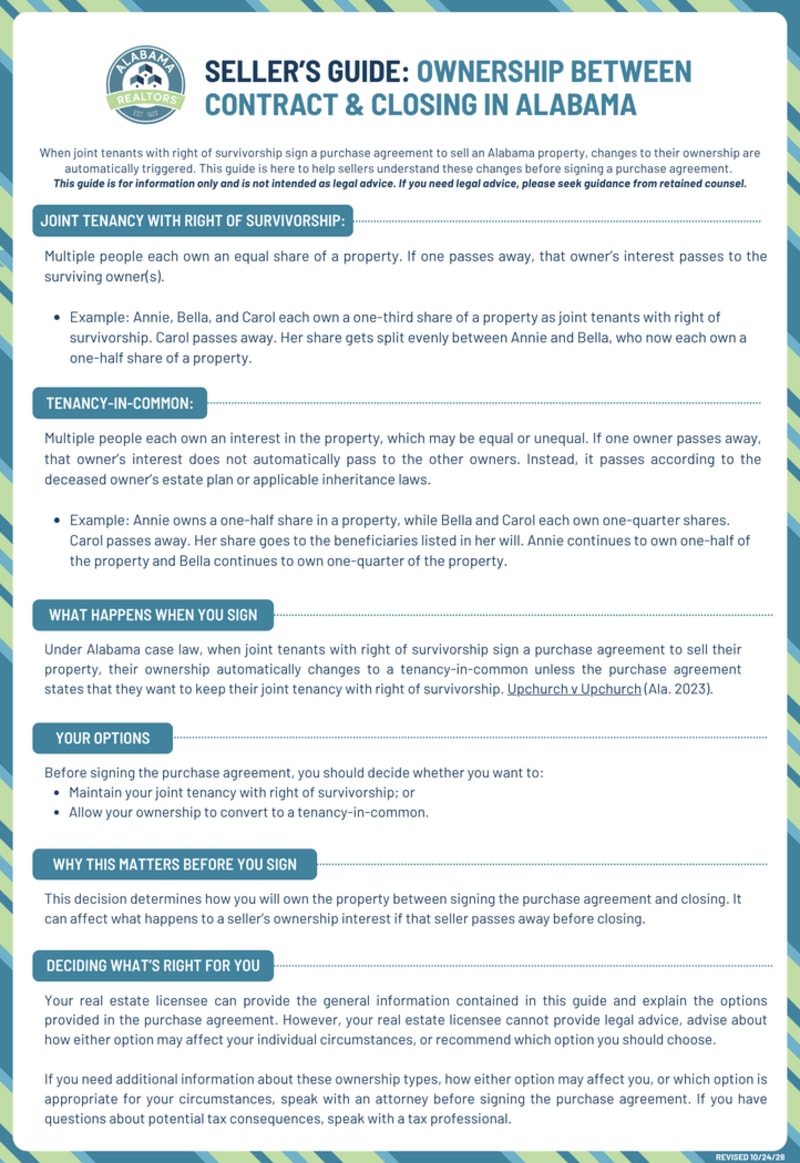
Joint tenancy is a type of ownership where multiple people each have an equal interest in a property. Right of survivorship means that if one of the owners passes away, the other owner(s) absorbs the deceased owner’s interest in the property. For example, if two people own a property as joint tenants with right of survivorship and one passes away, the surviving person would then have 100% of the ownership interest in the property.
Tenancy-in-Common is a type of ownership where multiple people each own an interest in a property. Their shares may be equal or unequal. With tenancy-in-common, if an owner of the property passes away, their share of the property passes to their estate/heirs, rather than to the surviving owners. For example, if two people each own a 50% share of a property as tenants-in-common and one passes away, the surviving person would still own 50% of the property. The deceased owner’s 50% share passes according to the deceased owner’s will or the inheritance laws of the state they lived in.
I’m not used to seeing this language in a Purchase Agreement. Why is it included?
This language is included in AAR’s Purchase Agreements following several Alabama appellate court opinions, the most recent being Upchurch v. Upchurch (Ala. 2023). In that case, three family members owned a property as joint tenants with right of survivorship. The three owners decided to sell the property and executed a Purchase Agreement. However, before closing, one of the owners passed away.
Based on the joint tenancy with the right of survivorship rules discussed above, when it was time to distribute the sale proceeds, the two surviving owners argued that they were each entitled to half of the sale proceeds. However, the deceased owner’s estate argued that it was entitled to the deceased owner’s one-third share of the sale proceeds because he passed away after the Purchase Agreement was executed but before the sale closed. The Alabama Supreme Court sided with the deceased owner’s estate. It ruled that when joint tenants with right of survivorship execute a Purchase Agreement, their joint tenancy automatically converts to a tenancy-in-common. The only way to prevent this automatic conversion is by including language in the Purchase Agreement that specifically says the sellers wish to maintain their status as joint tenants with right of survivorship. If that language isn’t included, the joint tenancy will become a tenancy-in-common from execution of the Purchase Agreement through closing.
The change in ownership type happens automatically when a Purchase Agreement is executed, even if the Purchase Agreement does not address it. AAR includes this language in its Purchase Agreements to bring this issue to the sellers’ attention before the Purchase Agreement is executed. This gives sellers the opportunity to determine which option is best for them.
Why does it matter whether the sellers are joint tenants with right of survivorship or tenants-in-common?
If a seller passes away between signing the Purchase Agreement and closing, the type of ownership determines whether that seller’s interest passes to the surviving owner(s) or becomes part of their estate.
When does Paragraph 13 of the Purchase Agreement apply?
This section applies when you are working with multiple sellers who own the property as joint tenants with right of survivorship. If you are working with an individual seller, or if you’re working with multiple sellers who are already tenants-in-common, you can select “not applicable.”
What is my responsibility as a real estate licensee?
When working with multiple sellers, the best practice is to determine how they own the property when you’re preparing the listing. If they own the property as joint tenants with right of survivorship, your job is to explain what this section means and define terms for the sellers. You should not give them advice or help them make the decision. The following steps are recommended no matter what purchase agreement the buyer uses to make an offer:
- Ask the sellers: When working with multiple sellers, ask them how they own the property. If they are tenants-in-common, there is no need to address this issue. If they are joint tenants with right of survivorship, it does apply. If they don’t know, check the deed for language about a “right of survivorship.”
- If it is clear that the sellers do not have a right of survivorship, this issue does not apply.
- If you can’t tell from the deed whether the sellers have a right of survivorship, do not try to interpret the deed. Direct the sellers to an attorney for assistance. Your job is to identify a possible right of survivorship so it can be addressed before the sellers sign the purchase agreement.
- If it is clear from the deed that there is a right of survivorship, or if the sellers tell you that they own the property as joint tenants with right of survivorship, move on to the next step.
- Define the terms. Define joint tenancy with right of survivorship and tenancy-in-common (TIP: use AAR’s Definitions Guide to help).
- Explain what happens when they sign. In Alabama, executing a purchase agreement automatically changes their ownership from joint tenants with right of survivorship to tenants-in-common unless they state otherwise in writing before signing the purchase agreement.
- Explain how they can keep their right of survivorship. The sellers can state in the purchase agreement that they want to remain joint tenants with right of survivorship. If they don’t take this step, they will become tenants-in-common when they sign the purchase agreement.
- Do not help them decide. You can define and explain the options, but you cannot recommend or suggest which option the sellers should choose.
- Refer questions to the appropriate professional. If the sellers have questions about how they own the property or their legal rights, direct them to an attorney. If they want advice about which option they should choose, or what tax implications their decision may have, direct them to an attorney and/or tax professional.
What are my limitations as a real estate licensee?
Both Alabama real estate license law and the REALTOR® Code of Ethics prohibit real estate licensees from practicing law. In this context, you may explain what each ownership option means and what happens under each option, but you may not counsel the sellers about which option is best for them or give advice about whether the sellers should maintain their joint tenancy with right of survivorship. If the sellers want advice or need help determining which option is best for them, direct them to an attorney and/or tax professional.
FAQs
What if the purchase agreement I am using does not address joint tenancy with right of survivorship?
Downloadable Resources
Licensee's Guide
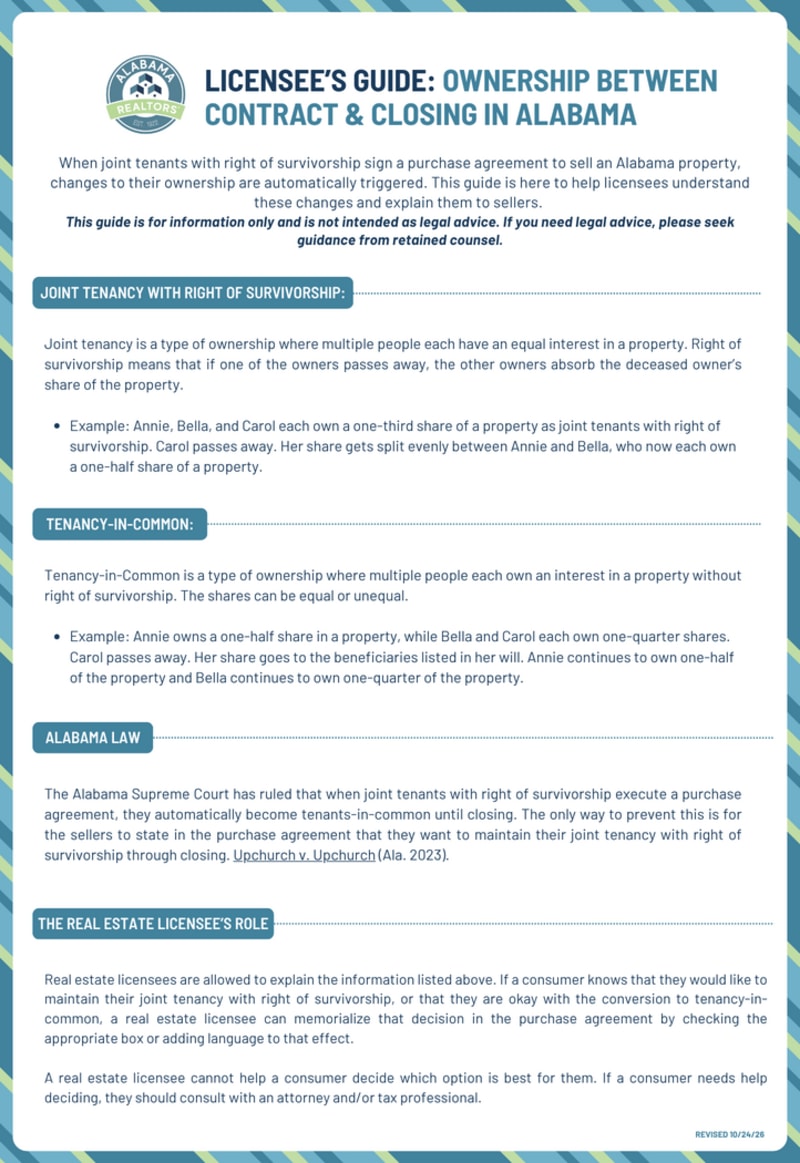
Seller's Guide
Visual Examples